

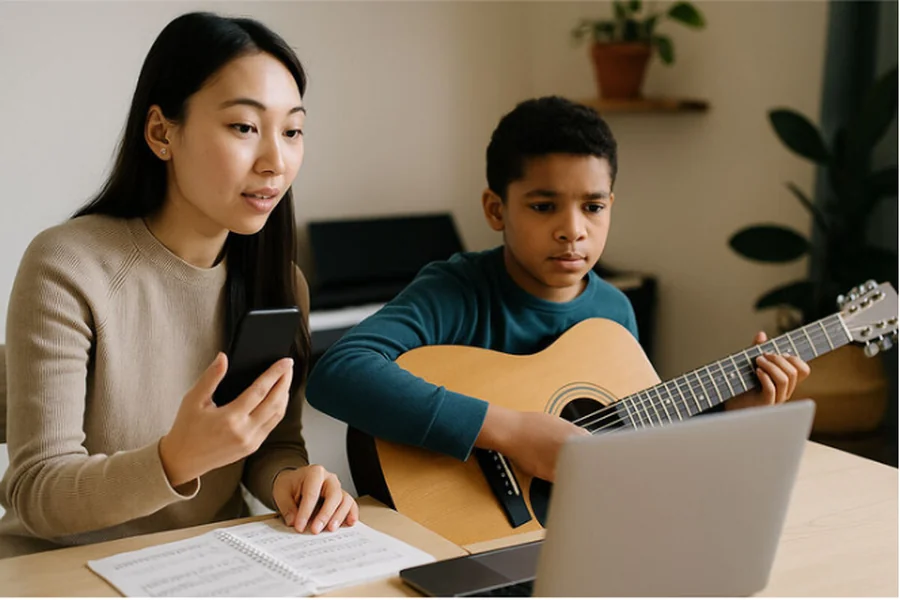
It can feel daunting to get started with music. You’ve got rhythm, pitch, and notation competing for your attention, all while fighting to stay inspired. What if you were able to hear what you’re learning, even without an instructor nearby? That’s the beauty of today’s tools: they allow you to listen while you learn, and that subtle move is enough to make theory sound. Let’s dive in.
Early on, practice videos, printed sheets, and metronomes reigned supreme. They work. But they don’t offer interaction or flexibility. That’s where voice‑driven technology enters the picture. And yes, text to speech tools can fill that gap by reading musical instructions, theory, or lyrics out loud, bringing every lesson to life instead of leaving it static. It’s not the headlining act in music ed, but it shifts the entire experience.
Why is hearing more important than reading, and how does it assist?
Newbies absorb instruction better when they hear it. Not only notes, but verbal instructions: “play staccato,” “emphasize this beat,” “sing this phrase.” Having that in your ear while you practice makes it feel like a dialogue rather than a solitary gaze at sheet music.
Voice tools can recite scales, describe phrasing, or call out errors in real time. Rather than interrupting to read “play softer on beat two,” you hear it. That maintains momentum, concentration, and makes practicing more natural.
Accessibility and flexibility keep students motivated and interested
Not every novice learns exactly the same way. Some learn by observing notation; others by listening. With spoken instruction, students with reading difficulties or who are blind or visually impaired aren’t excluded. It’s not about taking away sheet music; it’s about adding an extra track that explains and emphasizes what’s on the page.
Also, voice tools enable learners to stop, rewind, speed up, and slow down. All on their own schedule. No rewinding a video or flipping pages. That alone makes lessons seem accessible, not structured.
Layering instruction over music apps, online lessons, or what the student is using
Music sites tend to draw on video or text. With voiceover narration layering on top, each lesson gets a narrator: “Try that chord again,” “Now move to the next scale.” Even ad-supported tools that just speak out instructions can make a solo practice session into a guided one.
Some new AI work connects music performance to speech synthesis. For instance, there is a model that extends the concept behind spoken‑voice synthesis to the task of producing expressive instrumental performances from notated scores. It’s not widespread yet, but it illustrates the ways in which speech technology and music performance can collide in unexpected ways.
When music theory comes to be something you can listen to, rather than read
Abstract concepts like chord progressions, intervals, and phrasing make more sense when spoken. Voice tools can describe how a sequence moves or what tension it creates. That gives context when you’re trapped on a page of symbols. Suddenly things click: “that minor‑second leap is meant to feel uneasy,” or “this resolution lands on the tonic – notice that calming effect.”
Beginners stay motivated when they feel immersed
A lesson that responds is alive. Having an audio guide narrate your next move, such as slowing the rhythm or softening the tone, connects you to the music beyond labels. It makes every session a loop: do something, and the instrument reacts.That feedback, even when it’s in text to speech form, keeps the spark going.
Community and DIY tutors are able to make learning come alive
Not all emerging artists get to work with tutored instructors. Voice tools provide creators, including local instructors and amateur music bloggers, with a method for infusing lessons with personality, without the need for voice actors. Pre-recorded text-to-speech requests can direct entire lesson series and sound deceptively personable, particularly when students can manipulate voice speed or tone.
Where does this all head next?
We already have tools for producers that apply TTS to enhance tracks with narrative and atmosphere. In education, scientists are creating platforms to tailor lessons to individual learners, which immediately create exercises or feedback via AI. As technology advances, anticipate systems that listen to how you play and provide voiced advice – “try again,” “lift your fingers,” “feel that beat.
Voice synthesis cannot ever replace melody, instrument, or human instructor. But for beginners, hearing advice in the moment is a game-changer. It provides music with a voice before you have one of your own.
Final Words
Text to speech is subtly transforming the way newcomers experience music. By converting written instructions to verbal guidance, it naturalizes practice, facilitates lessons, and makes theory clearer. It doesn’t substitute teachers or instruments but provides a voice that keeps students interested, particularly when learning from the beginning. As the technology becomes more precise, it will further define the way new artists learn, listen, and feel their way through every note.Occasionally, listening is the best way to truly comprehend.