

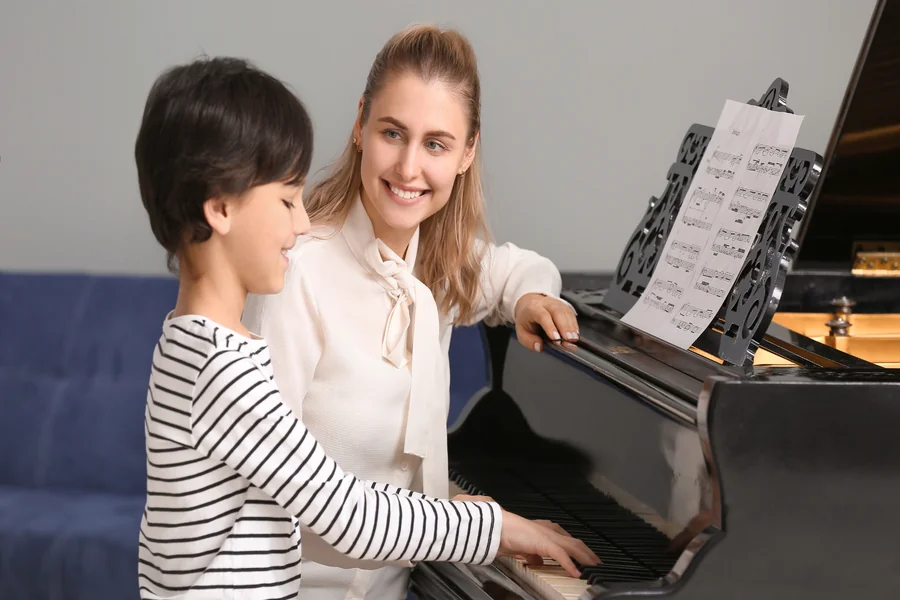
Here’s what typically happens when someone decides to learn piano on their own: things start well enough, maybe even exciting. Then reality hits. Your fingers refuse to do what your brain tells them. That simple melody? It sounds more like a kindergarten recital has gone wrong. Yet students working alongside professional teachers sail through these same challenges.
What gives? It’s not about natural talent; that’s a myth. The real difference is expert guidance shaping every practice session. Scientific research confirms this, showing that piano training under professional supervision produced measurable cognitive gains, including better selective processing and inhibitory control. This isn’t a feel-good theory. It’s concrete proof that home-based piano lessons led by qualified instructors outperform solo learning every single time.
Maximizing the Benefits of Piano Tutor Expertise
Nashville’s transformation into a music education powerhouse makes perfect sense when you consider its deep musical roots. The city draws instructors who blend traditional technique with contemporary approaches, all shaped by one of America’s most dynamic music scenes. These educators constantly evolve their teaching methods by absorbing diverse musical influences.
Families searching for quality instruction frequently find that working with piano lessons in Nashville opens doors to teachers who’ve actually performed professionally while simultaneously honing their pedagogical approach. This rare combination, stage experience plus teaching mastery, creates learning conditions you’ll never extract from streaming videos or instructional books.
Customized Curriculum Design
Professional instructors throw rigid textbooks out the window. They’ll evaluate what drives you, classical masterworks, jazz improvisation, and contemporary pop, and construct your curriculum around those motivations. This adaptability maintains engagement without sacrificing foundational skills.
Great teachers also possess radar for when to challenge you and when to pull back. They’ll detect your struggle with a concept and pivot their explanation, something no pre-packaged course can replicate.
Strategic Practice Techniques
Most self-taught players miss this crucial insight: your practice method matters infinitely more than practice duration. Expert instructors introduce powerful techniques, chunking difficult passages into digestible segments, implementing spaced repetition to cement learning, that compress your learning timeline dramatically.
They’ll also reveal mental practice strategies, the visualization techniques that professional musicians swear by. Improving your playing without touching the instrument sounds absurd until you experience the results firsthand.
The Science Behind Accelerated Learning with Expert Piano Tutors
Professional instruction literally rewires how your brain acquires musical ability. Left to your own devices, you’re flying blind, assuming you’re getting it right when you might be building a house on sand.
Neuroplasticity and Guided Skill Acquisition
Each practice session creates fresh neural pathways in your brain. Sounds promising, right? Except when you practice alone, there’s nobody to tell you if you’re making mistakes. Those incorrect patterns become muscle memory, hardening into habits that’ll haunt you later. Expert teachers intercept these errors instantly, guaranteeing your brain wires itself correctly from session one.
Consider this analogy: picking up conversational Spanish from an app versus learning from someone who grew up in Madrid. The app gets you somewhere, sure. But you’ll develop bizarre pronunciations that sound totally normal to your ears, until a native speaker winces and gently corrects you.
Personalized Learning Paths vs. Generic Methods
Your brain doesn’t process information like everyone else’s. Visual learners need to see the technique demonstrated. Auditory learners thrive on verbal explanations. Kinesthetic learners must physically experience the motion. Cookie-cutter YouTube tutorials serve the masses, which means they serve no one particularly well. A skilled instructor, though? They decode your learning style and adjust accordingly.
Research following children through six months of structured training revealed 100% retention rates, strongly suggesting that personalized programming keeps students motivated far beyond what self-directed methods achieve. This isn’t random luck; it’s the inevitable result when instruction aligns with how you actually learn.
Effective Piano Learning Tips from Professional Instructors
Professional teachers possess hard-won knowledge accumulated over decades. They’re not hoarding secrets, but these insights don’t exactly announce themselves to self-learners either.
Foundation Building Strategies
The benefits of piano tutor expertise become undeniable when you observe how they weave music theory into lesson one. They don’t present theory as dry regulations to memorize; they demonstrate how grasping chord progressions makes learning new material exponentially faster.
Sight-reading represents another domain where expert guidance proves transformative. Self-taught pianists rarely develop robust sight-reading because they lack the progressive exercise sequence that systematically builds this skill.
Technology Integration
Modern, effective piano learning tips embrace strategic technology use. Professional instructors distinguish which apps genuinely accelerate learning (rhythm trainers, ear development tools) from time-wasting gimmicks. They might deploy MIDI keyboards for visual feedback or recording software so you can track your evolution.
The critical distinction: technology enhances their instruction rather than substituting for it. The human element, someone who spots your wrist tension before it becomes chronic or catches your tendency to rush tempo, remains utterly irreplaceable.
Overcoming Common Obstacles in Piano Lessons for Beginners
Every beginner encounters roadblocks, but those obstacles manifest differently for each person. This is precisely where having an expert piano teacher at home becomes transformative.
Age-Appropriate Teaching Methods
A preschooler requires drastically different instruction than a teenager or adult. Young children need brief sessions packed with movement and playful elements. Teenagers respond to goal-focused teaching connected to music they genuinely enjoy. Adults typically want to understand the reasoning behind techniques, not just blindly follow directions.
Professional teachers fluidly modify their approach based on developmental stages. They’ve guided hundreds of students and know what resonates with each age bracket.
Individual Learning Barriers
Rhythm comprehension defeats some students. Others possess solid rhythm but can’t synchronize their hands. Performance anxiety might paralyze one learner while another battles perfectionism that sucks all joy from practice.
Qualified instructors identify these specific challenges and deploy targeted solutions. They’ve encountered every common barrier and plenty of unusual ones, so student difficulties rarely catch them unprepared.
The Real Value of an Expert Piano Teacher at Home
Let’s examine return on investment, because quality instruction carries a real price tag. However, the wasted time and corrective costs you avoid by learning correctly initially often dwarf that upfront investment.
Time Efficiency
Self-taught pianists typically spend months cementing bad habits that require additional months to unlearn. That’s time you could’ve invested in actual progress with proper guidance from day one. Professional instruction compresses your learning curve substantially.
Long-Term Benefits
Beyond piano proficiency, piano lessons for beginners with expert teachers cultivate cognitive abilities, self-discipline, and emotional awareness. These advantages compound across years, influencing academic achievement, professional success, and life satisfaction.
Consider how different approaches compare:
| Learning Method | Typical Progress Timeline | Bad Habit Risk | Engagement Level |
| Self-Taught (Videos/Books) | 18-24 months to intermediate | High | Moderate (drops over time) |
| Group Classes | 12-18 months to intermediate | Moderate | High (social element) |
| Expert One-on-One Instruction | 8-12 months to intermediate | Low | Very High (personalized) |
The data tells the story: personalized expert instruction accelerates your progress while minimizing frustration along the way.
Taking Your First Steps Toward Musical Excellence
Professional piano instruction converts learning from frustrating guesswork into a defined, attainable journey. You’ll sidestep the pitfalls that sabotage self-taught students while establishing solid technique supporting lifelong musical development. The investment in expert guidance yields returns not merely in piano ability but in brain development, discipline, and personal fulfillment.
Whether you’re starting fresh or returning after decades away, working with a qualified instructor multiplies your success probability exponentially. Don’t watch another year disappear, wishing you could play, connect with an expert teacher, and launch your musical journey properly.
FAQs on Expert Piano Instruction
1. How quickly can I expect results with professional piano instruction?
Most students play recognizable simple melodies within 4-6 weeks with consistent practice. Technical mastery unfolds over months, but you’ll observe steady advancement with expert guidance that sustains motivation through challenging phases.
2. Can adults learn piano effectively, or is it mainly for children?
Adults frequently progress faster than children due to superior focus and self-discipline. Professional instructors adapt methodologies for adult cognitive styles, making genuine proficiency entirely achievable regardless of starting age.
3. What should I look for during a trial lesson with a potential instructor?
Observe how they break down concepts and whether they respond flexibly to your questions. Strong instructors exhibit patience, deliver clear explanations, and express authentic interest in your aspirations rather than robotically following predetermined curricula.