

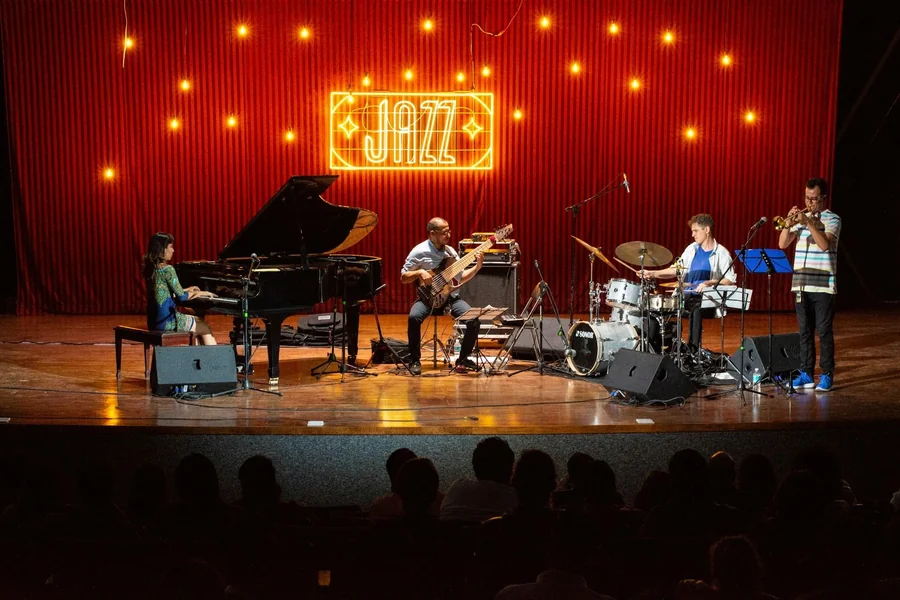
For over five decades, the Newport Jazz Festival has been a standard-bearer of creativity and musicianship, attracting jazz’s finest to the Rhode Island shores. It has welcomed legends and newcomers to its stages, delivering performances that not only encapsulate an era but also transform the future of music.
Just as the thrill of new sounds, the excitement of new frontiers is the same elsewhere; those in search of new experiences naturally look to familiar guideposts, like at Online-Casinos.com, where fans can find the best online casinos selected with today’s audiences in mind.
The Festival’s Historic Beginning
The Newport Jazz Festival was initially produced in 1954 by the idea of socialite Elaine Lorillard and jazz impresario George Wein.
Presented at the Newport Casino, the festival was unprecedented in its scope and ambition, the first outdoor jazz festival of its kind in the United States. The festival’s success created a lasting legacy that would influence generations of artists and concertgoers.
Newport was distinctive from the beginning in its presentation of a broad spectrum of jazz styles: from swing and bebop to avant-garde and fusion. The openness helped extend the festival’s popularity and served to underscore its mission: to celebrate jazz in all its forms.
Miles Davis’ 1955 Breakthrough
One of the most mythic moments in Newport’s history came in 1955, when Miles Davis showed up unannounced at an all-star jam session. Davis was fighting personal demons and career woes at the time, but his heartfelt playing on “‘Round Midnight” resurrected his career.
The set led directly to his signing with Columbia Records and the formation of his iconic first quintet. This is commonly called the turning point, not only for Davis but for the Newport Jazz Festival itself, which permanently established it as a venue where history could be made.
Duke Ellington’s Triumphant Return in 1956
Another milestone was set only a year later. Duke Ellington, whose career some thought had reached its peak, delivered a rousing set that reasserted his position as one of the supreme figures in jazz.
His orchestra’s performance of “Diminuendo and Crescendo in Blue” brought the crowd to its feet, with Paul Gonsalves’ now-legendary 27-chorus tenor saxophone solo being one of the most mythic moments in live jazz history.
The 1956 concert not only revitalized Ellington’s career but also showed the power of Newport in changing the direction of even the most established careers.
The Emergence of Free Jazz in the 1960s
The 1960s were a breakthrough decade when Newport embraced the more experimental sound of free jazz and avant-garde musicians. Ornette Coleman and Charles Mingus were among those who appeared with new, daring ideas in hand, pushing traditional forms of jazz and fueling intense debates among critics and enthusiasts.
These performances enlarged the festival’s character, revealing its commitment to pushing the boundaries and providing a forum for the genre’s development.
Ella Fitzgerald and the Vocal Jazz Tradition
While instrumental virtuosity dominates the spotlight, Newport also ensured the place of vocal jazz on the global stage. Ella Fitzgerald’s performances during the 1970s continue to evoke memories as milestone events, emphasizing her unparalleled range, improvisational genius, and charismatic showmanship.
Her ability to connect with audiences brought the festival to a new level, reminding listeners that jazz is as much about emotion and storytelling as about technical brilliance.
Fusion and the New Sound of the 1970s
The 1970s also saw jazz fusion come to Newport. Weather Report and Herbie Hancock’s Headhunters performances galvanized audiences, blending jazz improvisation with funk, rock, and world music influences. These groundbreaking performances drew in younger audiences and expanded jazz popularity beyond hardcore fans.
Newport fusion transformed the gulf between jazz purists and those committed to contemporary sounds, solidifying the festival’s tradition of innovation and eclecticism.
Wynton Marsalis and the 1980s Renaissance
When jazz faced new challenges in the 1980s, Newport once again provided the stage for a renaissance. Trumpeter Wynton Marsalis emerged as a key figure, bringing renewed popularity to jazz’s traditional styles. His playing celebrated the music’s tradition while reaching the contemporary listener, making jazz continue to live and breathe.
Marsalis’ concerts also attracted a new generation of concert-goers, many of whom were hearing jazz for the first time at Newport.
Legendary Reunions and Milestones in the 1990s and 2000s
The Newport Jazz Festival continued through the 1990s and 2000s, often serving as the venue for historic reunions and tributes. John Coltrane and Thelonious Monk were among the giants who were saluted in sets that furthered their traditions, while younger performers such as Diana Krall and Norah Jones drew in newer fans.
This period demonstrated that Newport was capable of reconciling tradition and modernity, offering a festival that catered to both jazz enthusiasts and those who simply enjoyed listening.
The Lasting Legacy of Newport
The Newport Jazz Festival remains a cornerstone of the global jazz calendar to this day. Its legacy is testament to the power of live music to uplift, heal, and inspire. The festival has not only hosted some of the greatest names in jazz but also supported new voices who are carrying the genre forward.
The performances over the decades demonstrate an astounding fact: Newport is more than just a festival: it is a living, breathing history of jazz.
Conclusion
From Miles Davis’ debut in 1955 to the boundary-pushing performances of the 21st century, Newport Jazz Festival has always been a platform where artistry prevails and legends are created. Its capacity to stay contemporary and yet be true to its heritage makes it one of the most significant cultural events in the history of American music.
As listeners look back on its most iconic performances, one thing is sure: Newport’s stages have given us more than iconic concerts: they have given us milestones that continue to shape the very definition of jazz.